Reducing Friction in Enterprise Self-Serve Onboarding & Unlocking Product-Led Growth

Summary
I led the design of Apollo’s first enterprise self-serve funnel — a new activation path that let large organizations explore, trial, and adopt GraphOS without sales involvement. The goal was to transform Apollo’s sales-led growth engine into a scalable, product-led motion by making enterprise evaluation faster, clearer, and value-driven. This work established the foundation for GraphOS self-serve activation, shortening enterprise sales cycles, improving predictability, and expanding adoption beyond traditional sales channels.
Focus: Enterprise, sales, activation, and personalization
Role & Scope
Title: Staff Product Designer, Growth & Developer Experience
Mission: Make Apollo self-serve and enterprise-ready so companies could evaluate securely, reach proof-of-concept faster, and reduce the sales cost of adoption.
Design Challenge
Design an enterprise-ready self-serve trial that reflected the speed and simplicity of GraphQL itself, allowing developers to onboard, activate, and adopt without a sales call.Apollo’s sales-led model didn’t scale. The product needed to build trust through experience, not human mediation.
Overview
Apollo is the company behind GraphOS Studio — a platform that helps organizations manage how their APIs talk to each other. For enterprise teams, GraphOS connects dozens of internal data sources into one secure API, streamlining development, improving collaboration, and providing fine-grained access control.
Cross-Functional Partners
- Growth & product leads: aligned revenue goals and qualification criteria
- Head of product marketing: aligned product and web messaging
- Head of content & learning: supported documentation and training
- Head of sales: coordinated changes to sales processes and expectations
Problem Details
Enterprise adoption of GraphOS required trust, security, and scalability — but Apollo’s onboarding flow worked against those needs:
- Required API credentials on the first screen (excluding 60%+ of users)
- Silently routed everyone to the free serverless plan, losing high-intent evaluators
- 92% drop-off after sign-up
- Heavy dependence on enterprise contracts and Sales Engineering support

Why It Mattered
Enterprise evaluators needed a quick, low-risk path to see value and share it with their teams. Without it, conversion and trust eroded before sales ever engaged.
Team Challenge
Inside Apollo, “enterprise adoption” meant different things to different teams:
- Marketing: “Users don’t understand GraphQL.”
- Engineering: “We just need more features.”
- DevOps: “We’re chasing the wrong users.”

Alignment was the blocker. To fix this, I led a 90-minute cross-functional workshop (product, eng, devRel, content). Within minutes, we surfaced language gaps, where terms like graph, project, and activation had inconsistent definitions. I introduced a shared glossary and ownership matrix for when to involve each function. Treating language as part of the design system shifted leadership focus toward user experience, not org boundaries.
Goals
- Business: Increase qualified leads and reduce sales overhead
- Enterprise: Enable secure, 30-day self-serve trials and drive adoption
- User: Deliver a faster path to proof-of-value, building trust and transparency
Early Insights
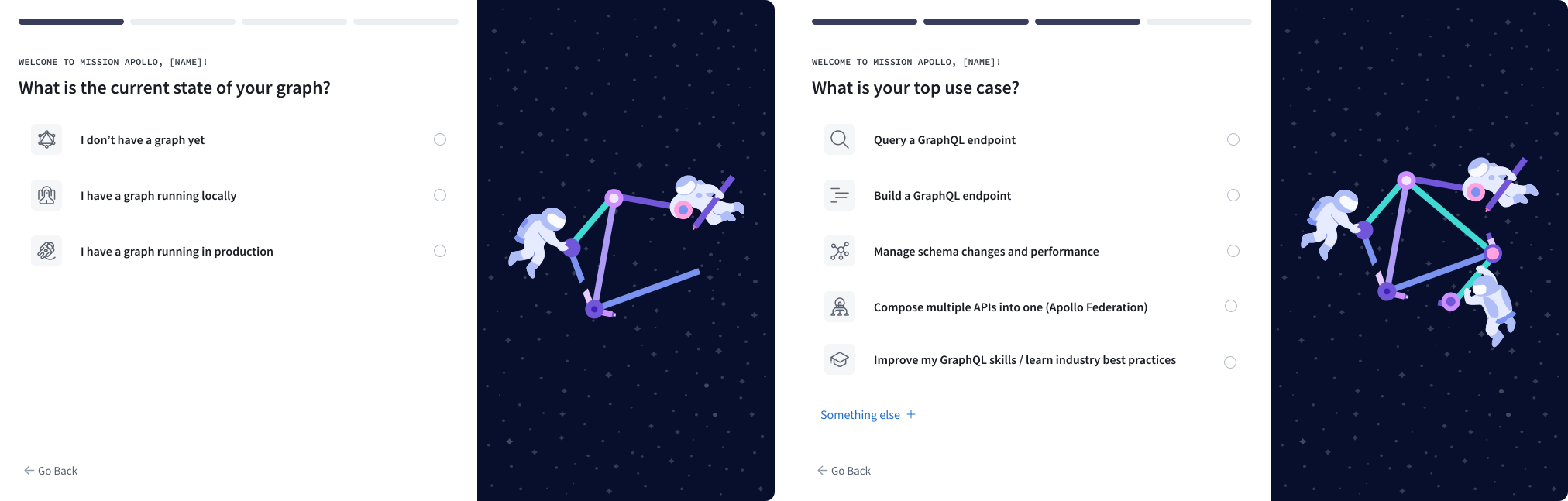
To understand intent, I added a three-question survey to the sign-up flow. Over 10k responses clarified friction points and user types. Here's a preview of the original onboarding survey implemented to understand more on our users intent & persona types.
Key Findings
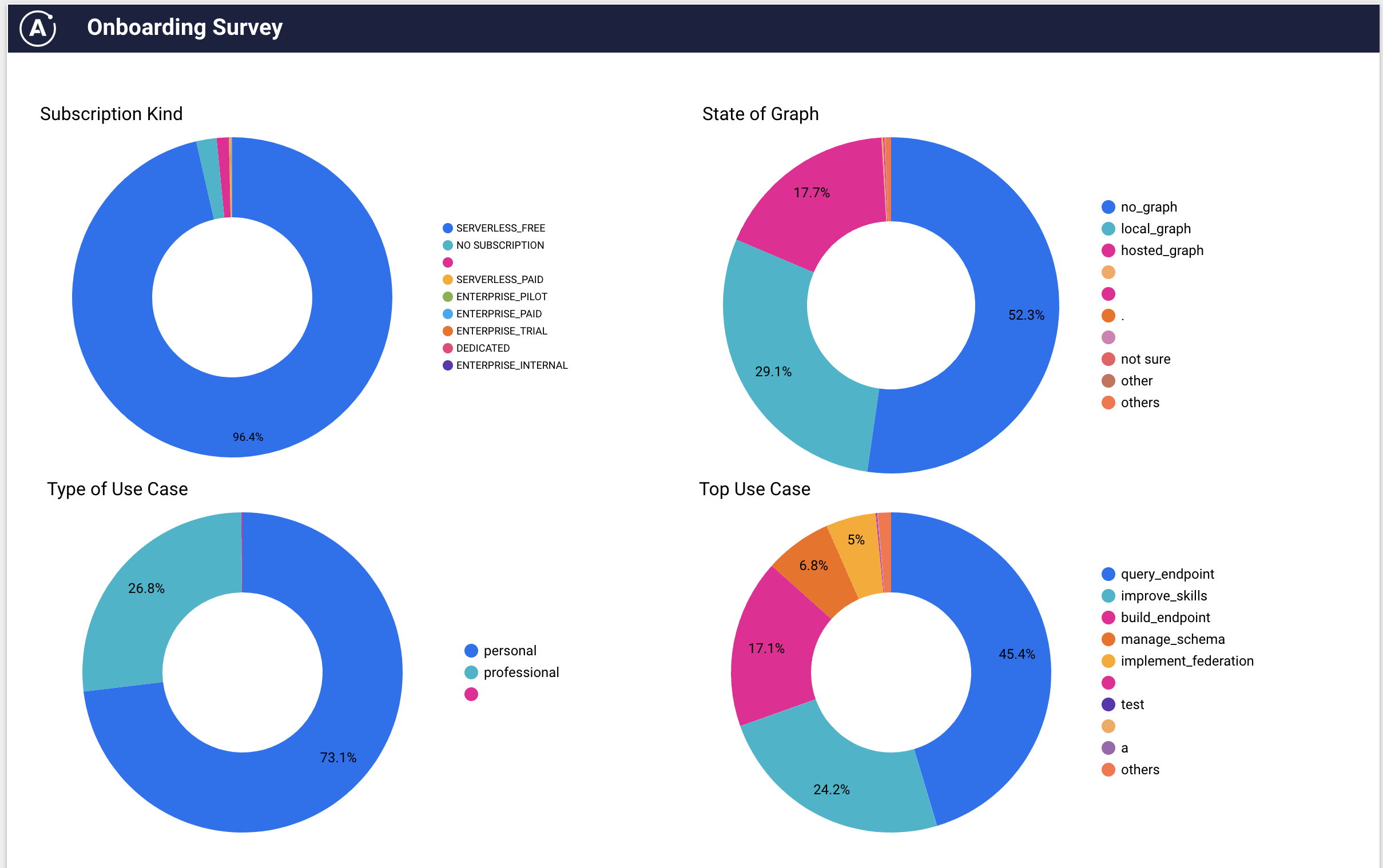
The data reframed the problem from “educate users on GraphQL” to “reduce steps before value.
- 49% had no graph or dataset; most enterprise evaluators dropped off early
- 47% came to run a query
- 73% were “personal” users (some enterprise users mis-categorized to avoid sales)
- 97% remained on the free plan
- 5% sought to implement federation (supergraph)
Approach
I approached the redesign as a systems problem, aligning user trust, business viability, and technical feasibility.
- Map the ecosystem: Audited onboarding flows; identified redundant validation and a 92% API gate drop-off.
- Uncover evidence: Paired quantitative funnel data with evaluator interviews.
- Define guiding truths: “Trust first, value fast, complexity unfolds over time.”
- Prototype for clarity: Tested progressive-disclosure flows balancing compliance and transparency.
- Scale cross-functionally: Rolled out in sync with marketing and sales enablement for consistent messaging.
Insights to Impact
Cross-team alignment merged Growth, Sales, and Dev Experience under a single adoption metric. Using Amplitude data, research panels, and internal listening tours, we validated that friction stemmed from trust gaps, delayed value, and limited real-world testing.This led to three design levers: personalized onboarding, modular demos, and scalable architecture.
Solution
A self-serve enterprise onboarding flow balancing compliance and conversion:
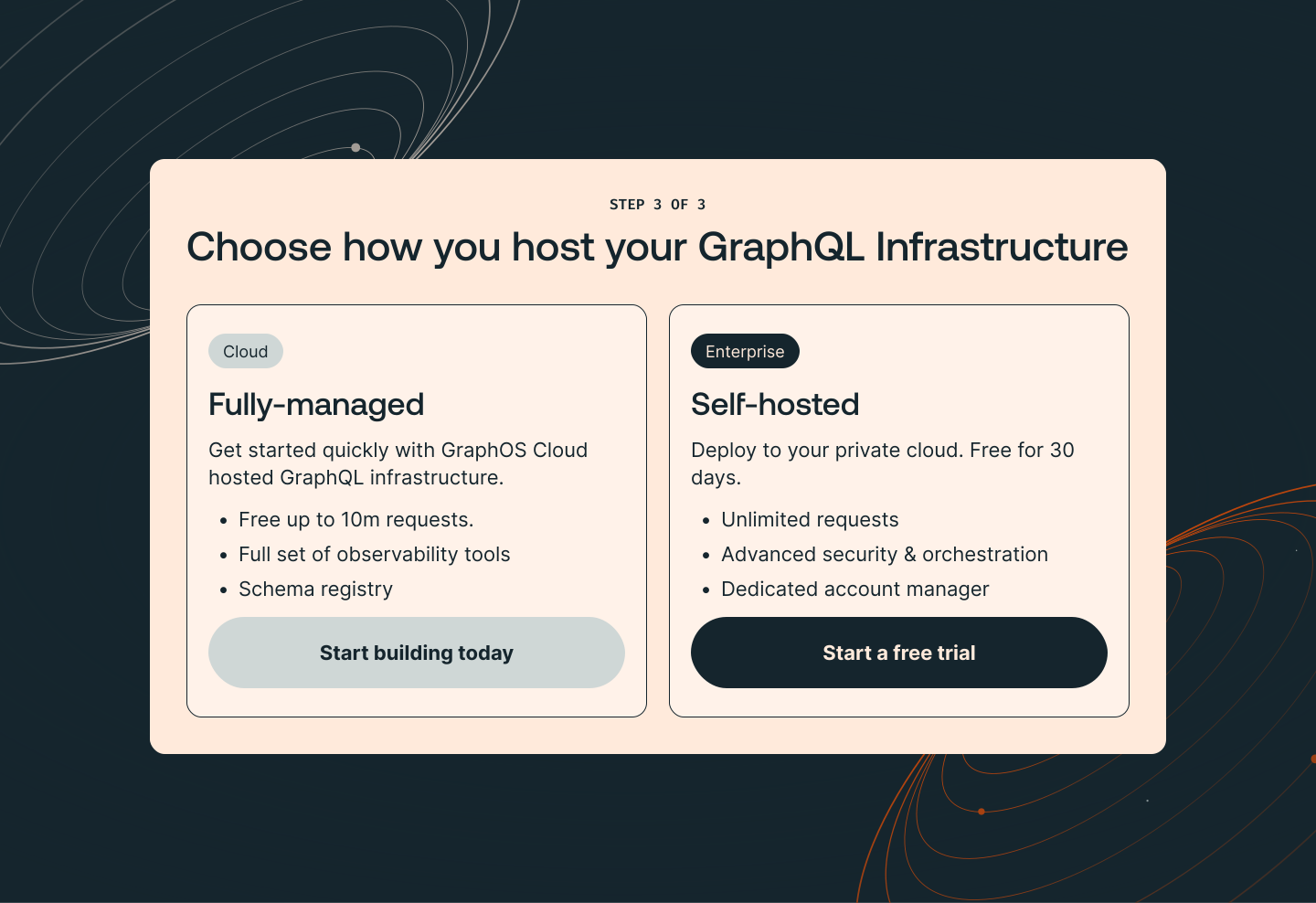
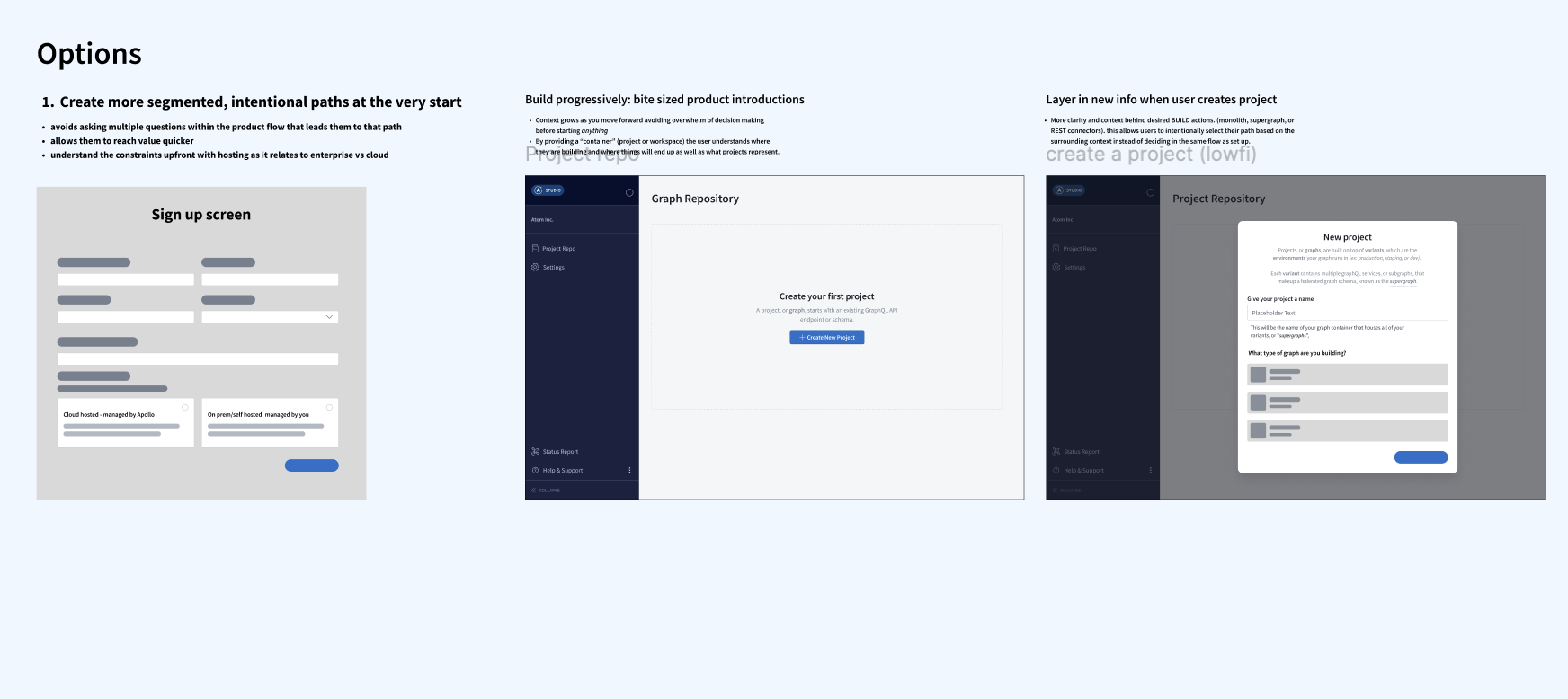
- Personalized pathways: Segmented users (explorers, beginners, adopters). Moved 30-day trial upfront for enterprise champions.
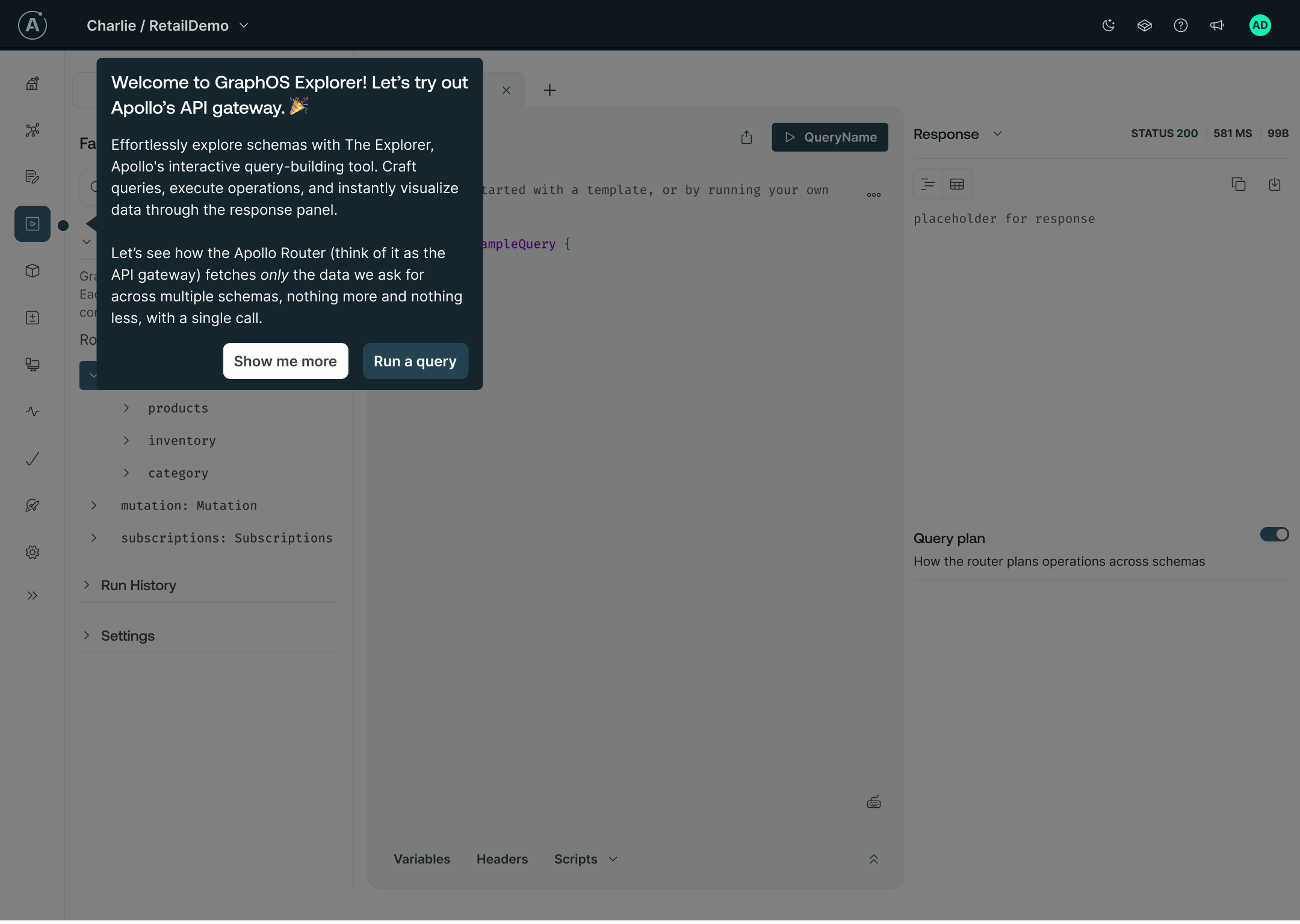
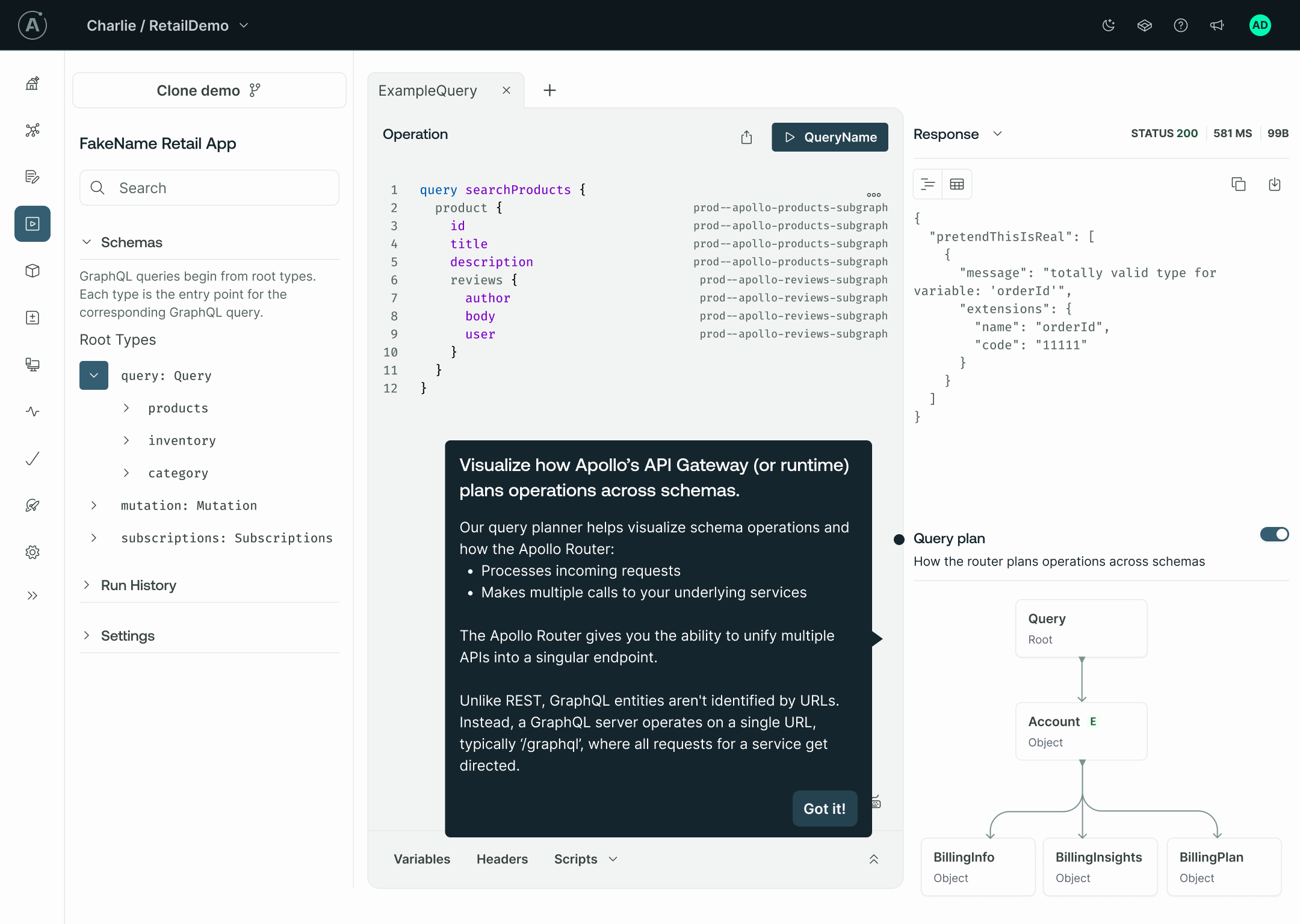
- One-click demo (“Spotify Demo”): Let users safely experience GraphOS instantly in a read-only environment.
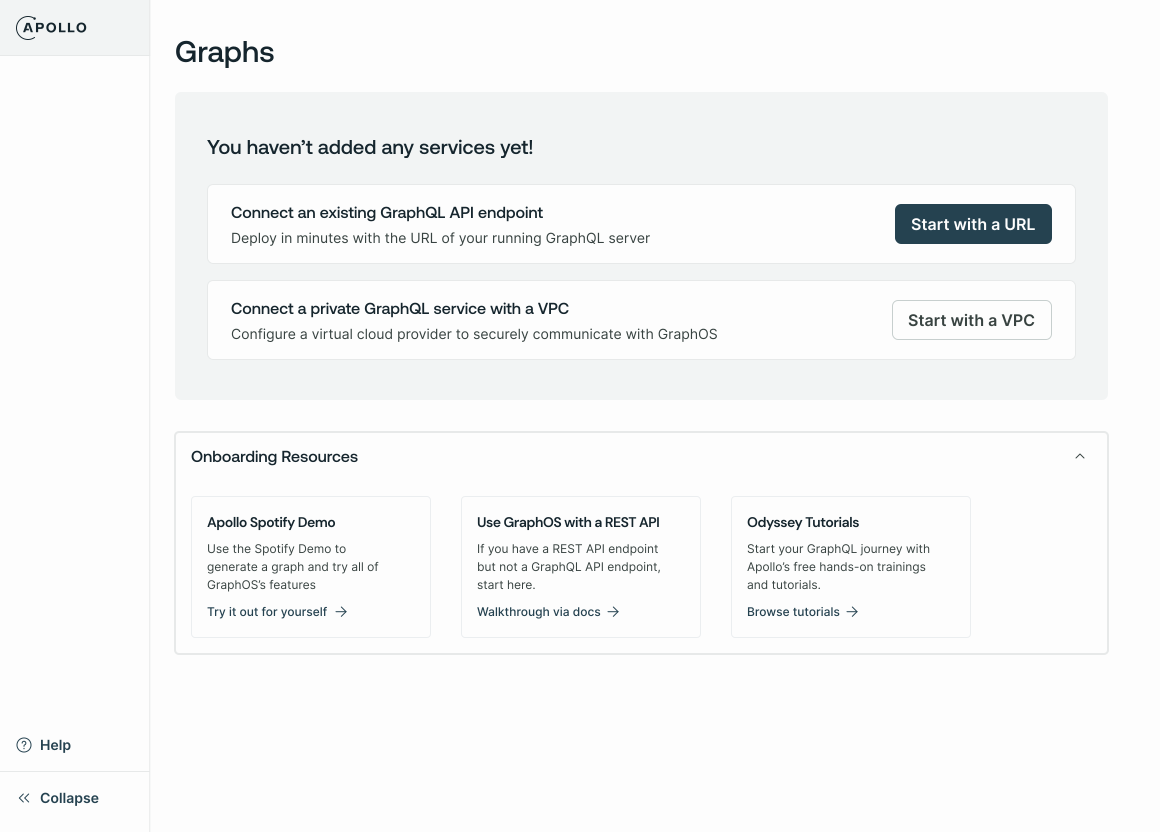
- Project containers: Introduced architectural grouping (graphs, services, variants) to mirror enterprise org structures.
Personalized Pathways (UI peak)
One click demo (UI peak)
Project containters (UI peak)

Outcomes
- 300% increase in enterprise trial signups (50% of all sales leads)
- Weekly trial signups: <1% → 4%
- 8% higher success rate for self-serve enterprise users vs. free tier
- 1,000+ new research opt-ins within 3 months
- Reduced sales overhead and cleaner lead signals
- Shifted market perception from “not enterprise-ready” to “secure, scalable, trusted.”
This work established Apollo’s foundation for product-led enterprise growth — reducing sales dependency, strengthening trust signals, and positioning design as a strategic function driving adoption, not just execution.